Authorized Trane Dealer Serving the North Shore
A furnace sized using sea-level heating load assumptions will underperform in a North Vancouver home sitting at 200 or 300 metres elevation where winter nights are colder, wind exposure is greater, and the heating season stretches longer than it does across the inlet. The system runs at or near full capacity more often than it should, struggles to hold temperature during cold snaps, and wears out faster than a properly sized unit would. Getting the sizing right before the equipment goes in is the single most important step in a furnace installation on the North Shore. Eaton's Heating provides free in-home assessments across all North Vancouver neighbourhoods that account for elevation and exposure. As an authorized Trane dealer and FortisBC Trade Ally, we install systems from Trane, KeepRite, and RunTru at multiple efficiency tiers and price points. Flexible financing through Financeit with zero percent interest over 12 months.


See what our customers have to say
Brands Serviced
Years of Experience
Homes Served and Counting
The difference between a furnace installation in Lower Lonsdale at sea level and one in Upper Lynn Valley at 250 metres is not trivial. The home at elevation faces colder overnight lows, longer sustained heating demand during cold stretches, and wind chill from mountain-facing exposure that the lower home never experiences. These factors change the heating requirements and, in many cases, change which furnace tier makes sense. A system that runs comfortably in a sheltered Norgate rancher may be undersized for a Blueridge split-level with two exposed exterior walls and a walk-out basement facing north. Our free in-home assessment measures the actual conditions: square footage, insulation levels, window area, ceiling height, duct sizing, and the specific elevation and orientation of the home. We size to the actual load rather than rules of thumb, because on the North Shore the difference between a well-sized furnace and an oversized or undersized one is more pronounced than in flatter, more sheltered cities.
North Vancouver's housing stock spans eight decades, and each era brings different installation considerations. Norgate's post-war ranchers from the late 1940s and early 1950s were built with low-clearance mechanical spaces and original ductwork sized for natural draft furnaces. Lynn Valley's split-levels from the 1960s and 1970s typically have full basements with adequate mechanical room height but aging trunk lines that may need sealing or partial replacement to handle the airflow of a modern blower. Edgemont and Canyon Heights homes from the 1970s and 1980s sit on sloped lots where the venting route from the furnace to the exterior wall requires careful planning around grade changes. Grouse Woods' newer homes from the 1990s and 2000s generally have modern ductwork and straightforward installations, but the higher elevation and greater wind exposure at that altitude demand proper intake and exhaust termination placement. We assess every North Vancouver home individually because the installation approach should follow from what the house requires, not from a standard template.
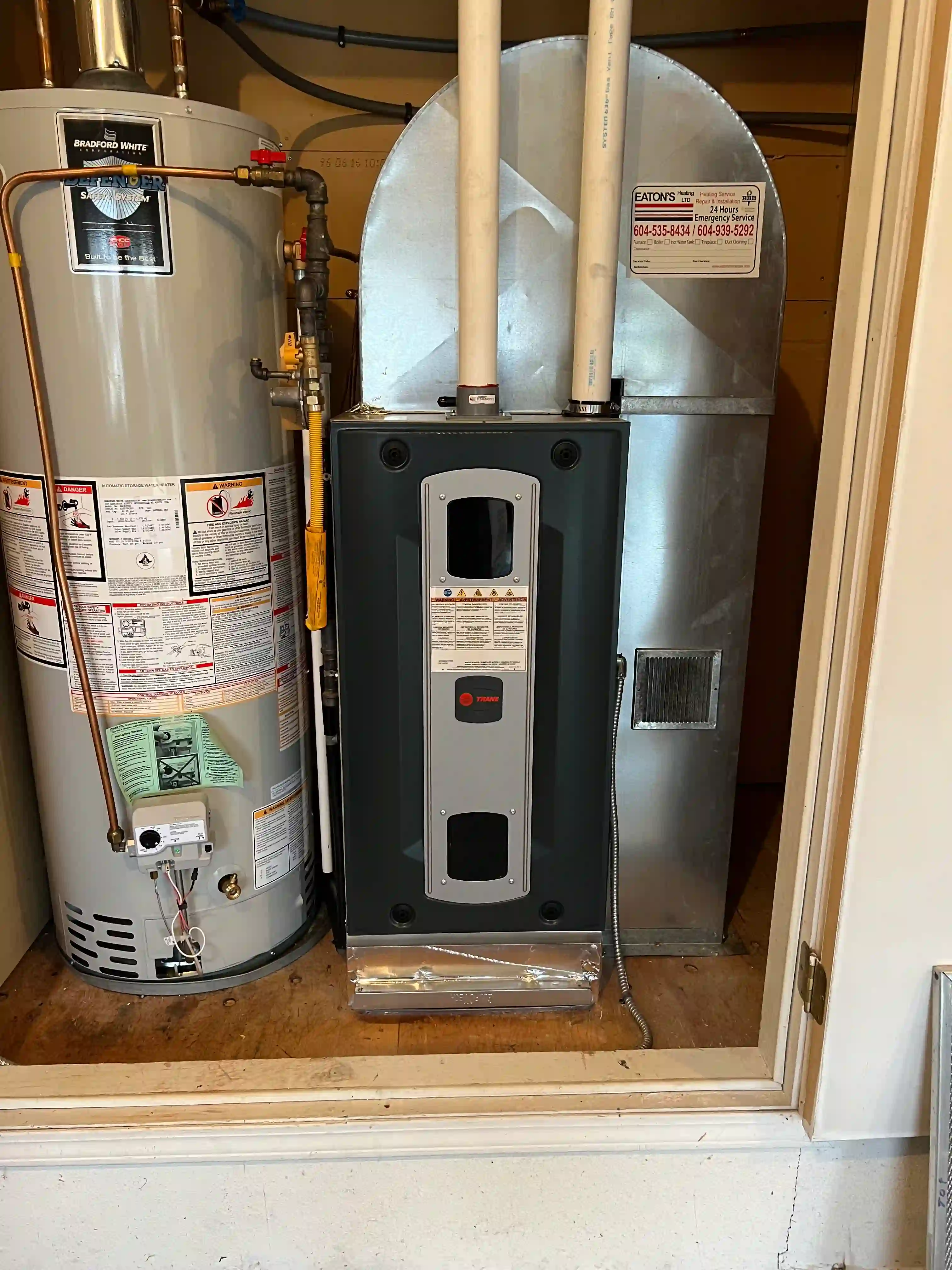
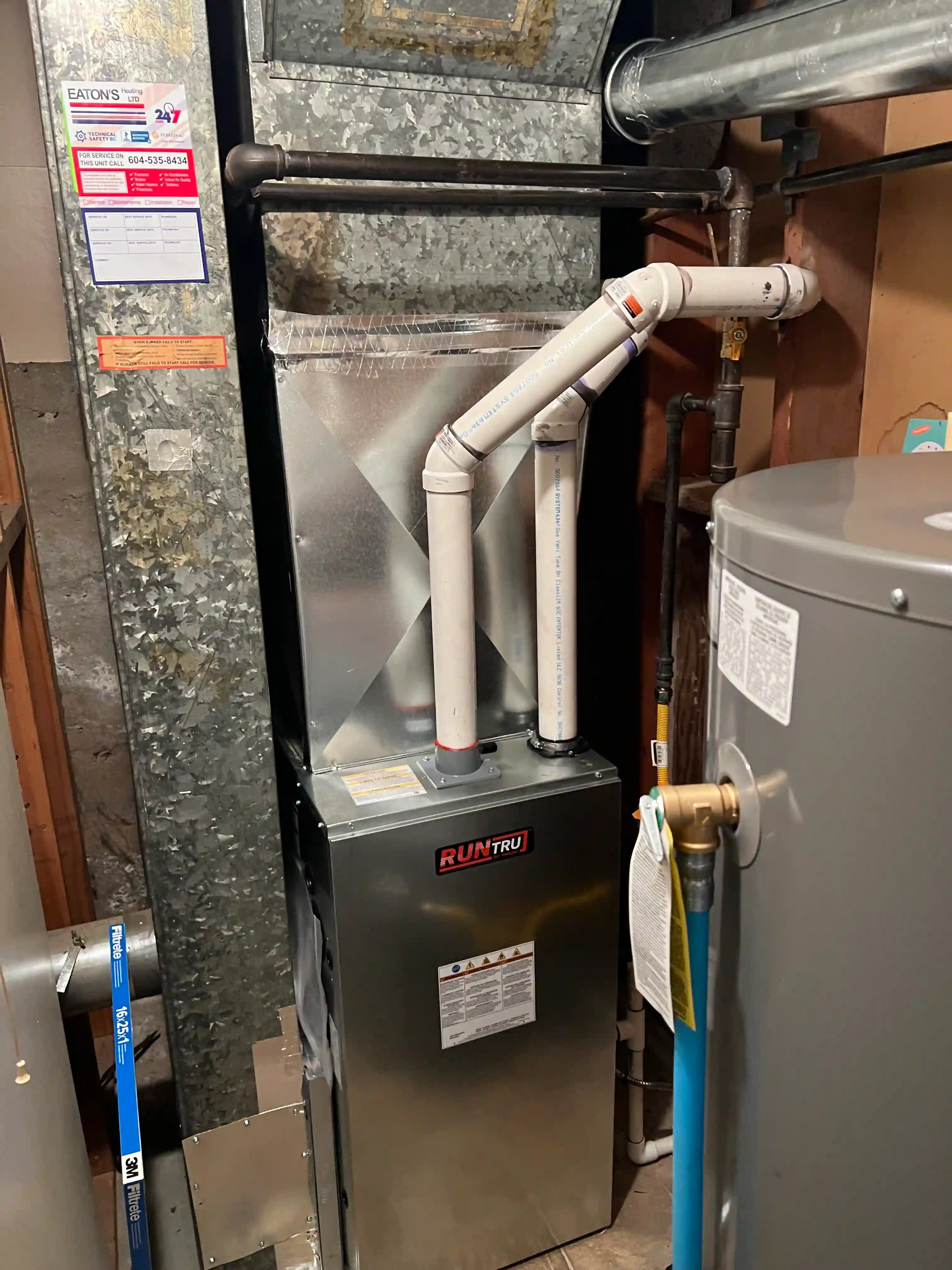
Eaton's Heating is the only authorized Trane dealer in Coquitlam, and we install Trane's full residential furnace lineup across the North Shore. For most North Vancouver homeowners replacing a mid-efficiency unit, Trane's two-stage condensing furnace at 96 percent AFUE provides the best balance of comfort and value: it runs at lower output most of the time and ramps up only during the coldest periods, which on the North Shore means it spends more time at high stage than the same unit would in a warmer location. For homeowners who want the quietest operation and most even heating, Trane's variable-speed tier reaches 97 percent AFUE and adjusts output continuously. Trane's premium modulating line tops out at 97.3 percent AFUE. For budget-conscious replacements, the RunTru line by Trane delivers 96 percent AFUE with the same core engineering at a lower price point, and the KeepRite two-stage at 95 percent AFUE offers another solid value option. We recommend based on the home's actual heating load and your budget, not on margin.
Two decades of furnace installation across Greater Vancouver's most varied residential landscapes inform every project we take on. Eaton's Heating is Technical Safety BC licensed under LGA0200006, holds FortisBC Trade Ally status, carries BBB A+ accreditation, and is Home Performance Contractor Network (HPCN) registered. Our team carries full WorkSafeBC coverage. Our 400+ five-star Google reviews and 4.9 average rating reflect properly sized, properly commissioned installations that deliver the efficiency numbers printed on the box. On installation day, we remove and dispose of the old furnace, convert venting from the old metal flue to PVC intake and exhaust, route condensate drainage, modify gas lines to current CSA code, install and test the new system with a full combustion analysis, and program your thermostat. We register factory warranties and walk you through the system before leaving. Most standard replacements across the North Shore are completed in a single day.
For North Vancouver homeowners weighing whether to stay with gas or move to electric heating, we also install heat pumps as either a full furnace replacement or a hybrid dual-fuel system that pairs a heat pump with a gas furnace. The hybrid approach is well suited to the North Shore because the heat pump handles mild to moderate cold efficiently while the gas furnace takes over during the coldest stretches at elevation. If the furnace needs repair rather than replacement, we provide an honest assessment of which path makes more financial sense for your situation.

Selecting a furnace for a North Vancouver home means accounting for what the house faces that homes south of the inlet do not. Deep Cove and Dollarton properties sit at lower elevation but face sustained moisture from Indian Arm that keeps basements damp year-round, making condensate management and corrosion-resistant venting essential. Pemberton Heights homes near the Capilano River deal with steep lot grades that affect where venting can terminate and how condensate lines are routed. The Delbrook and Central Lonsdale corridors have a mix of 1950s to 1970s homes where mid-efficiency to high-efficiency conversion involves capping the old B-vent flue and running new PVC through existing wall cavities. We evaluate each property during the free assessment and include all necessary work in the written estimate so there are no surprises on installation day.
During the free assessment, we also evaluate whether a different heating approach might serve the home better. Properties with existing radiators or in-floor loops may benefit from a modern boiler system rather than a furnace. Homeowners who want heating and cooling from a single outdoor unit can compare heat pump options against the furnace path. We price every viable configuration so you can weigh them on equal terms. Qualifying high-efficiency installations may be eligible for FortisBC incentive programs that reduce the net cost, and we handle the rebate application as part of the project. Visit our rebates page for current programs.
Licensed Gas Contractor (LGA0200006)
Authorized Dealer and Installer
Certified Fireplace Dealer
Have a question about your HVAC system? Book an appointment using the form below, or call (604) 535-8434 for immediate help.
Furnace sizing depends on the home's square footage, insulation levels, window area, ceiling height, and critically on the North Shore, its elevation and exposure. A 2,000-square-foot Lynn Valley split-level at 200 metres elevation with two exposed walls needs a higher-capacity system than the same square footage in a sheltered Lower Lonsdale townhome at sea level. We assess the home's actual heating requirements during the free in-home visit rather than using rough square-footage estimates, because an oversized furnace short cycles and wastes energy while an undersized unit runs continuously without reaching temperature. The assessment is free and the written estimate includes the sizing rationale.
What drives cost on the North Shore is less about the furnace itself and more about what the home requires around it. A straightforward replacement where the new unit connects to existing ductwork and the venting route is clear typically runs $5,000 to $7,000 installed, covering the furnace, PVC venting conversion, gas line work, condensate drainage, sheet metal, old unit removal, and commissioning. Hillside properties where the venting route must navigate grade changes, homes where ductwork needs modification to handle a modern blower's airflow, or multi-zone setups push the total higher. We provide free written estimates that itemize every line so the quoted number is the final number. Financing through Financeit with zero percent interest over 12 months.
Mid-efficiency furnaces (approximately 80 percent AFUE) use a metal B-vent flue that exhausts combustion gases vertically through the roof. High-efficiency condensing furnaces (95 percent AFUE and above) use sealed PVC intake and exhaust pipes that vent horizontally through an exterior wall. The conversion involves capping and sealing the old metal flue, running new PVC venting to the nearest suitable exterior wall, installing a condensate drain line to the closest floor drain or condensate pump, and modifying the gas line if needed for current code. In many North Vancouver homes from the 1960s and 1970s, the old flue runs through a chase that can sometimes be repurposed for other services. We handle the full conversion as part of every standard installation, and the cost is included in the estimate.
It can. Hillside lots, common across Pemberton Heights, Canyon Heights, the Upper Capilano area, and parts of Lynn Valley, affect furnace installation in a few ways. Walk-out basements may have the mechanical room on the downhill side, which changes where the PVC intake and exhaust terminate and how exposed they are to wind and rain. The exhaust termination needs to be positioned where prevailing winds will not force combustion gases back into the intake, and where wind-driven rain will not enter the pipe. Condensate drain routing on sloped lots may require a condensate pump if there is no gravity path to a floor drain. We evaluate all of this during the free assessment and account for it in the estimate. These considerations add modest complexity but are routine for technicians experienced on the North Shore.
Rebate programs through FortisBC and the province shift periodically in both eligibility and dollar amounts, so we verify what applies to your specific installation during the assessment rather than quoting outdated figures. Homeowners replacing mid-efficiency furnaces with qualifying high-efficiency condensing systems typically have the strongest rebate eligibility. We submit the application as part of the project and show both the gross and net cost in the written estimate so you can see the impact before committing. Visit our rebates page for current program details.
Most standard furnace replacements are completed in a single day. Our technicians arrive in the morning, remove and dispose of the old unit, complete the venting conversion, gas line modifications, and condensate drainage work, install and connect the new furnace, perform a full combustion analysis, verify gas pressure and airflow, program the thermostat, and register factory warranties before leaving. Installations requiring significant ductwork modifications, structural changes to accommodate new venting routes, or multi-zone configurations may extend to two days. We confirm the expected timeline during the assessment so you can plan accordingly.
Simply complete our form to make an appointment. A member of our team will be in touch to confirm your appointment.