Boiler and Hydronic Repair, Langley City and the Township
People who heat with water rarely want to heat any other way. Warm floors underfoot, radiators that hold a room steady without a fan ever switching on, none of the dryness that comes with blown air: hydronic heat earns its loyalty. Langley asks more of a boiler than most of Metro Vancouver, with inland winters that keep it firing from October into April and cold snaps the coast never feels. So when pressure starts dropping, a zone stops warming, or the unit locks out on a February morning, the fix starts with someone who works on these systems every week, not once a winter. Eaton's Heating repairs boilers and hydronic heating across Langley City and the Township. A boiler diagnostic is $189, and no repair happens until you have approved its exact price.


See what our customers have to say
Brands Serviced
Years of Experience
Homes Served and Counting
Langley's hydronic heat is concentrated at the two ends of the housing spectrum. At one end are the older homes: Fort Langley's character houses, Murrayville's early stock, and pockets of Langley City where radiators or baseboard convectors have been carrying the heat for fifty years or more, usually on their second or third boiler. At the other end are the custom and estate builds across the rural Township, where in-floor radiant is the comfort feature of choice and a single boiler may run the main floor slab, the bathroom loops, and a heated garage or shop besides. In between sit the renovations: combi units swapped in where an old tank and mid-efficiency boiler used to be, handling space heating and domestic hot water from one wall-hung box. Boiler repair across that range is less about the brand on the jacket and more about reading each system as it was actually piped, because no two of these installations went in the same way.
The heating season is the second factor. Langley's inland winters put boilers on long duty, firing daily from October, carrying the house through outflow cold the coastal cities never see, and still working into April. That is why late winter is when hydronic systems tend to give up: a circulator or ignition component that has been fading all season fails after months of hard running, not in the first cold week. On Township acreages the workload multiplies, with one boiler often feeding the house, a suite, and a heated shop through long loops that have to stay balanced across every building. We cover the full spread of the Langley area, and scheduling accounts for where the property actually is, whether that is a Langley City walk-up or an acreage on the far side of the Township.
The useful thing about hydronic faults is that the symptom usually points to a short list of suspects. One zone gone cold while the rest heat fine means the problem is in that loop: an airlock, a zone valve that is not opening, an actuator that hums but never moves. Pressure that sags week after week means the sealed system is losing water somewhere, or the expansion tank has lost its charge and the relief valve is quietly dumping the difference. A boiler that fires, runs briefly, and drops out is protecting itself, and the question is from what: flame signal, flow, or, on condensing units in unheated mechanical spaces, a condensate line that froze overnight. The $189 diagnostic follows the symptom to its source instead of starting at the boiler and guessing outward, because on a piped system the cause is often nowhere near where the problem shows up.
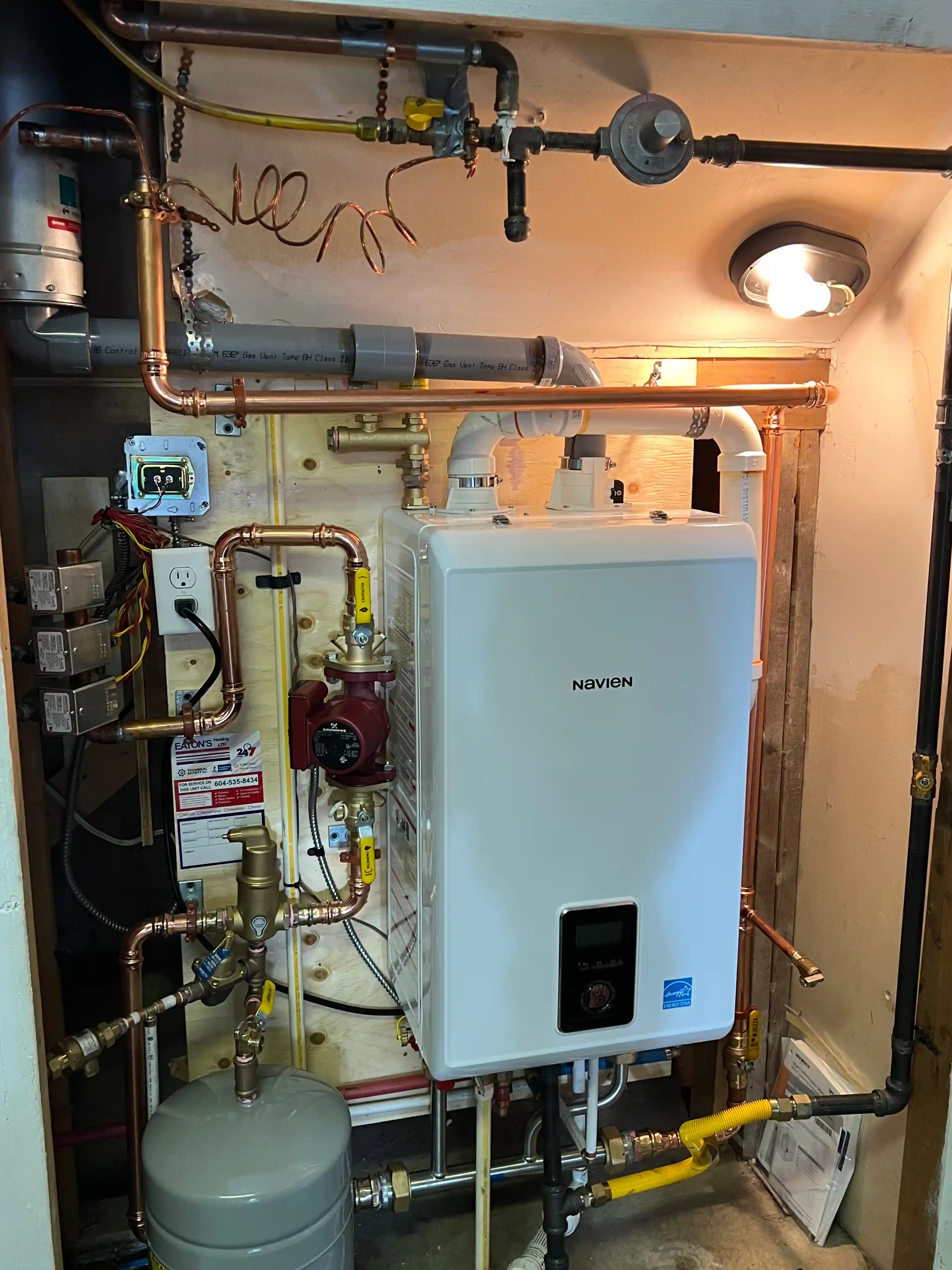
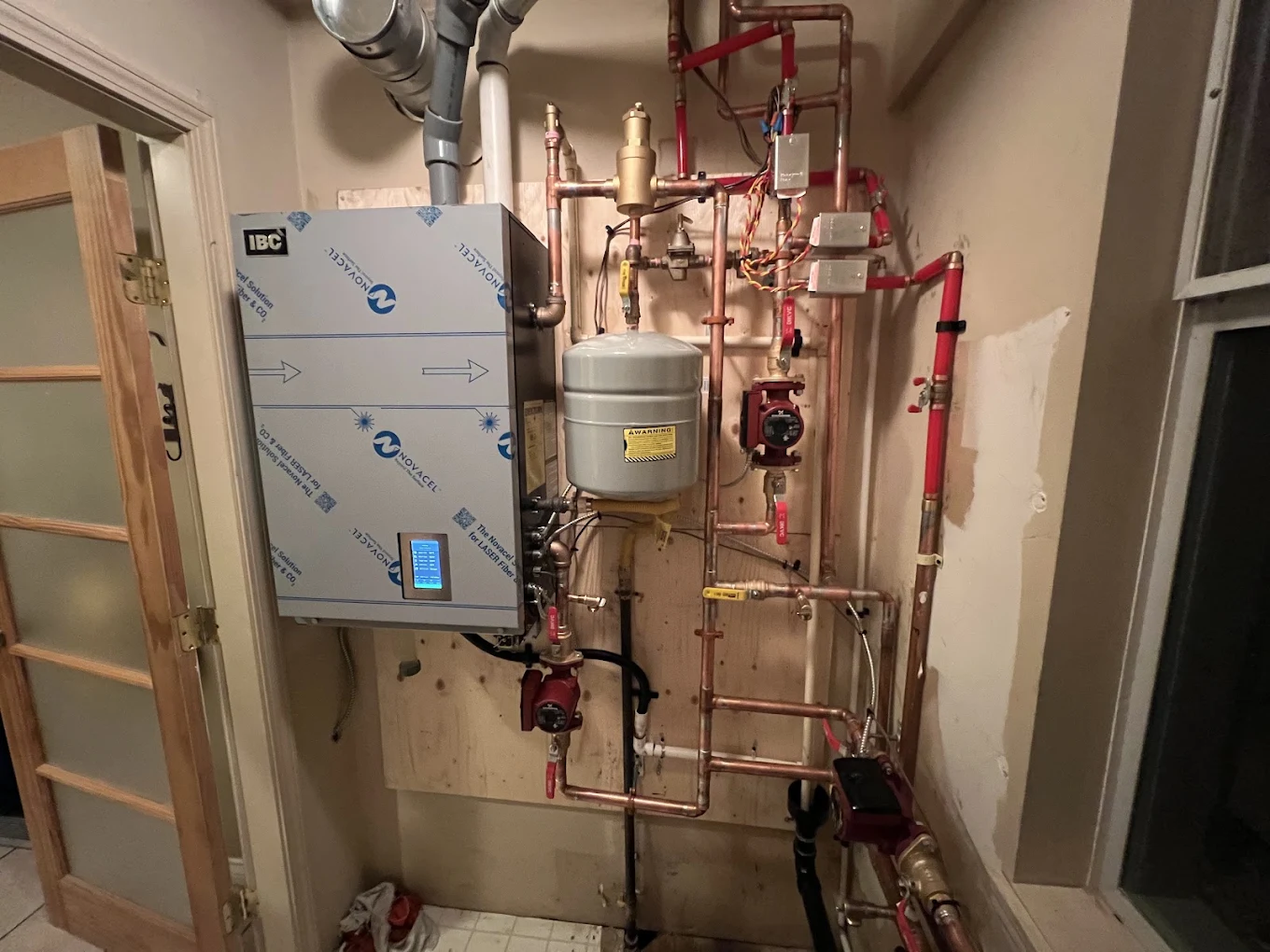
Knowing each brand well matters twice as much on boilers. The Navien, Viessmann, and Bosch condensing platforms each display and log fault codes differently, and the cast iron generation, Weil-McLain, IBC, NTI and their contemporaries, predates fault codes entirely, so a technician has to move between electronic diagnostics and old-fashioned hands-on troubleshooting without missing a step. Ours do, and the paperwork behind them is in order: Technical Safety BC licence LGA0200006, FortisBC Trade Ally status, BBB A+ accreditation, HPCN registration, WorkSafeBC coverage, and a 4.9 average across more than 500 Google reviews. Every part we fit is OEM and CSA certified, and the six-month warranty covers the labour as well as the part.
Two rules govern the repair-or-replace call. First, the distribution is the expensive half of a hydronic home and it is already in the walls, so a failed boiler almost never means abandoning radiators or radiant floors; a modern condensing unit drops into the existing loop. Second, when the failure is the heat exchanger on a unit past its mid-twenties, the repair math usually loses to boiler installation in Langley, and we put that comparison in writing rather than talk around it. What we will not do is sell a replacement to someone whose boiler needs a $400 pump.

Boiler calls get sorted by consequence. Anything leaking comes first, because a sealed system under pressure keeps feeding water to a failed fitting long after the burner shuts off, and in a finished basement that turns a heating problem into a flooring problem by morning. No-heat calls in radiant-only homes sit right beside them, since a slab-heated house has no furnace to fall back on. Routine problems, a zone that will not warm, an occasional lockout, a noise that comes and goes, get booked into regular appointment slots. All of it covers both municipalities and the rural Township on one schedule, no address too far east.
The dividing line between repairing and replacing usually runs through the heat exchanger. Pumps, valves, sensors, and ignition parts are worth fixing on almost any boiler that is otherwise sound; a cracked or scaled-out exchanger on a unit past twenty is where replacement becomes the smarter spend. When it does, qualifying high-efficiency boiler replacement can be eligible for FortisBC rebates that we confirm and file as a Trade Ally, and twelve months at zero percent through Financeit takes the sting out of the timing.
Licensed Gas Contractor (LGA0200006)
Authorized Dealer and Installer
Certified Fireplace Dealer
Have a question about your HVAC system? Book an appointment using the form below, or call (604) 535-8434 for immediate help.
It depends on what is wrong, and that is intentional. Leaks and no-heat calls, especially in homes where radiant floors are the only heat source, are dispatched same day across Langley City and the Township, including the acreage areas east and south of the urban core. Routine faults book into the next available window, usually within a day or two. Cold snaps compress everything, so if the boiler is limping in November, call before the outflow arrives rather than during it. (604) 535-8434.
The range is wider than furnace work, and it is worth saying that upfront. The diagnostic is $189 and covers tracing the fault through the whole system, not just the boiler cabinet. From there, the common repairs, expansion tanks, ignition and flame sensing parts, zone valves and their actuators, circulator pumps, mostly land between $200 and $800 in parts and labour depending on the part and the brand. Heat exchanger problems cost more and usually trigger the replacement conversation instead. Every number is quoted exactly and approved before work starts, parts are OEM and CSA certified, and the warranty runs six months on parts and labour.
Almost always one. A combi is a single appliance doing two jobs, space heating and domestic hot water, through one burner and one control board, so a single fault typically takes down both. Which side failed first is a useful clue: hot water gone while the heating limps on often points to the plate exchanger or diverter valve, while a full lockout points upstream to ignition, pressure, or flow. Combi failures get priority handling because the household loses two essentials at once. And if your hot water comes from a standalone unit rather than the boiler, that falls under our tankless water heater service instead.
That pattern is a genuine clue. On condensing boilers vented outdoors, Langley's below-freezing nights can ice the condensate line or vent termination just enough to trip a safety, and by the time anyone investigates, the ice is gone and the boiler resets clean. Marginal ignition components show the same behaviour, failing only under the long, hard call for heat that follows the coldest night. Repeated resets are the wrong tool either way, because each one clears the evidence and stresses the system. Note the fault code if the display shows one, note the weather when it happens, and hand both to the technician; that pairing routinely turns a mystery into a one-visit fix.
A partial failure generally means the boiler itself is fine and the problem is in the distribution. Radiant systems split into loops at a manifold, each with its own actuator and often its own thermostat, so one cold area usually means one dead actuator, one airlocked loop, or a mixing valve stuck at the wrong blend. Slabs complicate the timeline: concrete holds heat for a day or more, so the fault often happened well before the floor felt cold, and garage or shop slabs on larger Langley properties tend to show it first because they sit at the end of the longest runs. The fix happens at the manifold far more often than inside the boiler, which keeps these repairs on the reasonable end of the price range.
It is more annoying than dangerous, and yes, easily. The pilot going out is actually the safety system working: the thermocouple senses the flame, and the moment it cannot, it closes the gas so nothing flows unburned. When that cycle repeats every few days, the usual culprits are a thermocouple at the end of its life, a partially clogged pilot orifice, or a draft washing across the flame, all quick and inexpensive fixes on the boilers still running standing pilots in Langley's older housing stock. The one exception: if you ever smell gas near the boiler, skip the relight, leave the house, and call FortisBC's emergency line at 1-800-663-9911 before calling anyone else.
Simply complete our form to make an appointment. A member of our team will be in touch to confirm your appointment.