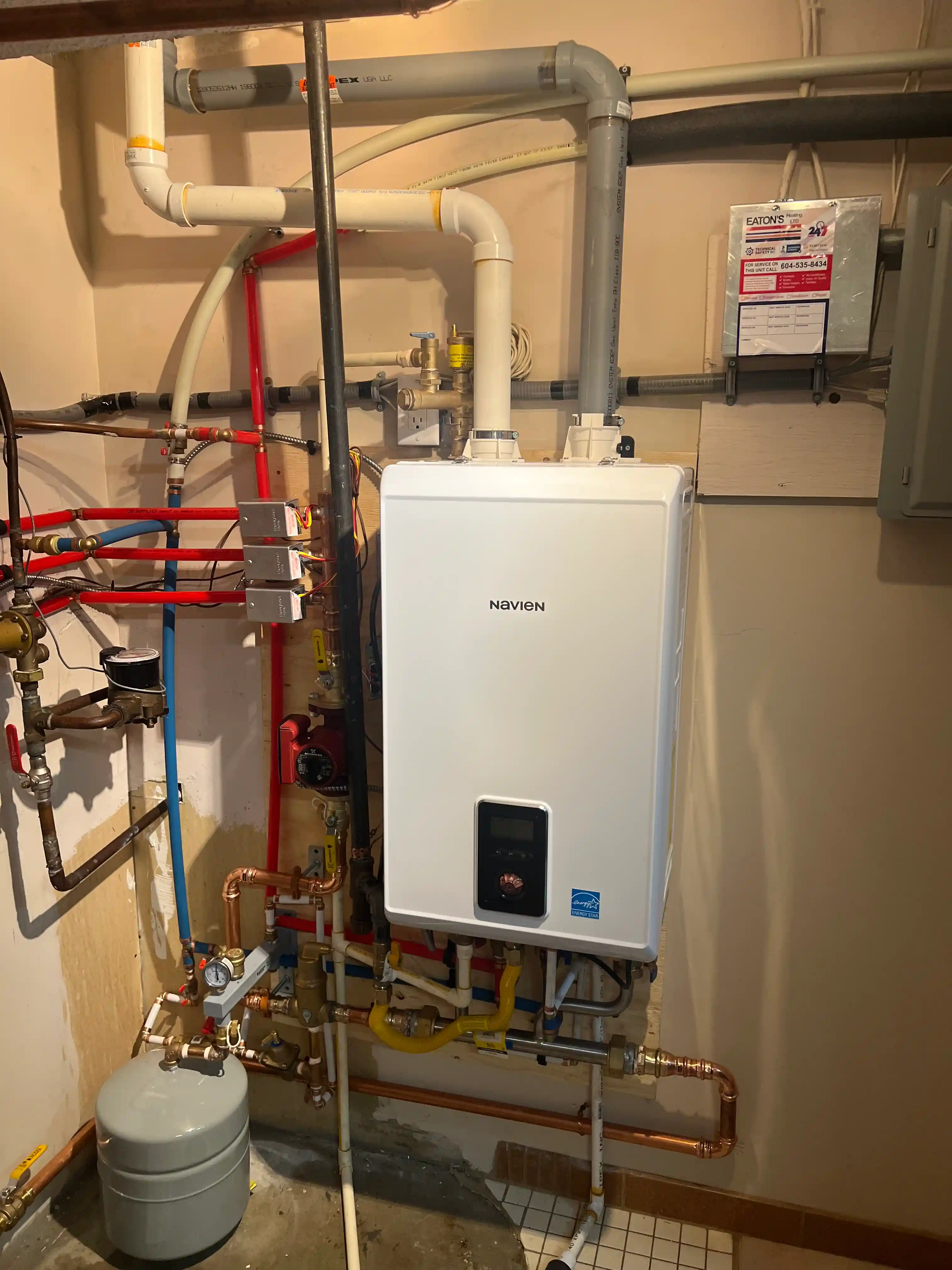
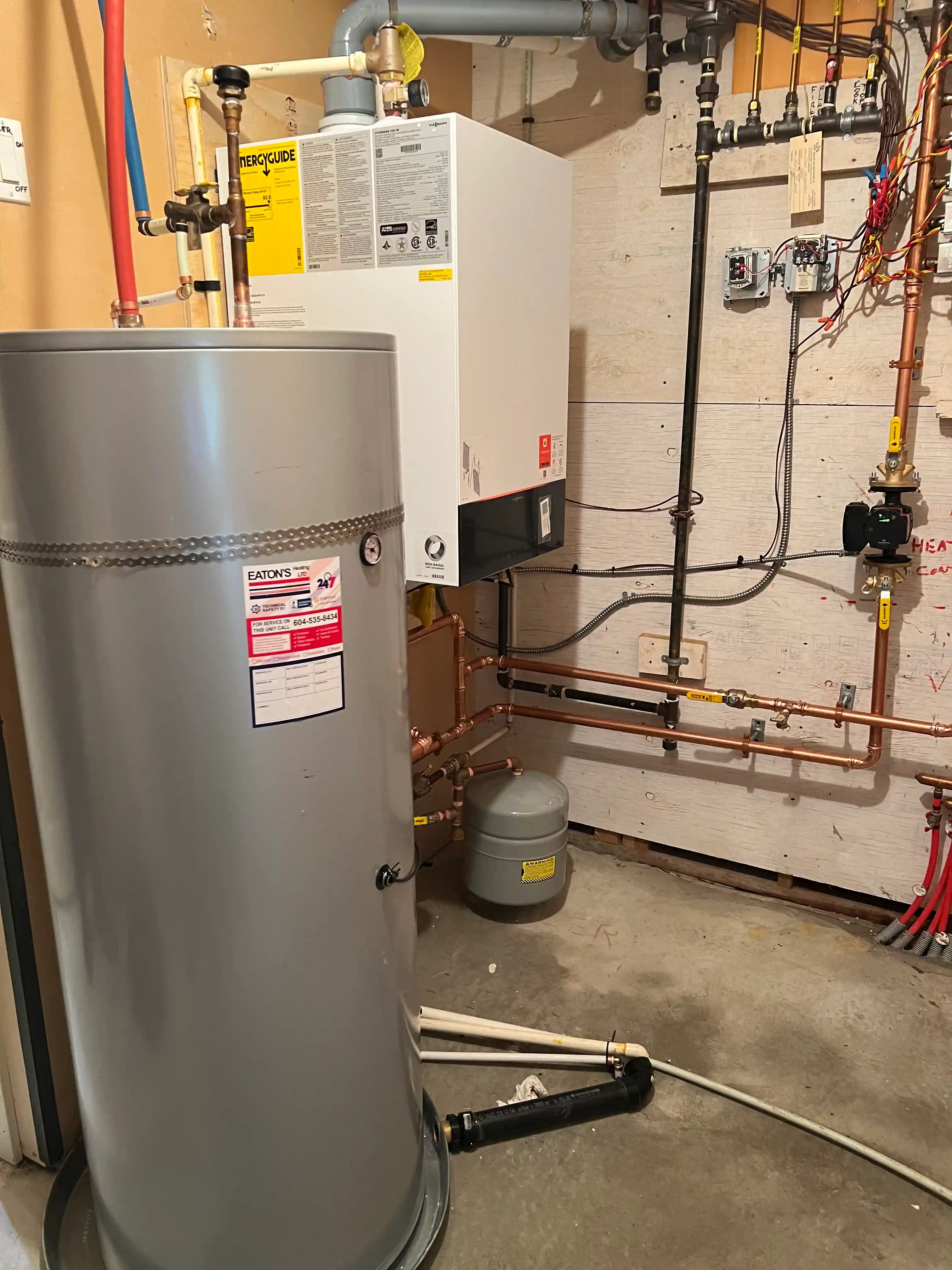
Boiler Installation and Replacement, Langley City and the Township
Half the value of a hydronic home is already paid for. The radiators, the in-floor loops, the piping buried in walls and slabs: that distribution outlives every boiler that feeds it, so replacing the boiler is really about upgrading the one part of the system that actually wears out. Done properly in Langley, that means a condensing unit sized to inland winters rather than coastal ones, tuned to whatever mix of radiators, radiant floors, and heated outbuildings the system serves. Eaton's Heating installs boilers across Langley City and the Township, carrying Navien, Viessmann, and Bosch. Every project starts with a free in-home assessment and a written, all-in price, with zero percent Financeit financing over 12 months available.


See what our customers have to say
Brands Serviced
Years of Experience
Homes Served and Counting
The most common boiler installation in Langley is the quiet upgrade: an older unit in a Fort Langley character home, a Murrayville original, or a Langley City walk-up reaching the end of its run, replaced by a wall-hung condensing boiler that connects to the radiators already doing the work. The radiators themselves almost never need to go; they routinely outlast three boilers. What decides how the project unfolds is everything between the boiler and those radiators, so the assessment starts there: how the loops were piped, which valves still operate, where scale has narrowed the flow, and what previous installers improvised along the way. A boiler replacement that accounts for the loop up front is the difference between a system that heats evenly on day one and one that struggles because of problems in the old piping.
The other end of Langley's boiler work is the big hydronic systems on rural Township properties. Estate homes and acreages through Campbell Valley, Glen Valley, and south Langley run radiant slabs, bathroom loops, suites, and heated shops or garages off a single boiler, and sizing there takes real care: several buildings with different heating needs, water temperatures that differ between a slab and a towel radiator, and circulation that holds up across the longest run on the property. Undersize the boiler and the shop slab never quite gets there in an outflow week; oversize it and the unit short cycles through the shoulder seasons. The free assessment settles the sizing, based on years of working on these exact multi-building setups, because on properties like these the equipment cost is the small half of getting it right.
Combi conversions sit in the middle and are increasingly the smart play in Langley's older housing. A combi replaces two appliances, the aging boiler and the hot water tank beside it, with one wall-hung unit that heats the house and produces domestic hot water on demand. The mechanical room gets its floor back, the cost of keeping a hot water tank hot day and night disappears, and one service visit covers everything. The honest limit is how much hot water the house uses at once: a household running multiple showers and appliances at the same time can outrun a combi's flow rate, in which case a heating-only boiler paired with separate hot water is the setup that keeps up. Which side of that line your household falls on is a usage question, and we settle it during the assessment rather than after the install.
The brand recommendation depends on the system. Navien's combi and heating-only condensing lines handle most straightforward Langley replacements and conversions. Bosch covers the mid-range across both configurations. Viessmann is the premium tier, the pick for owners planning to stay put for decades, and its high-capacity models are what we reach for on the large multi-zone acreage systems where lesser equipment runs flat out. That recommendation is based on what the loop needs and how the household uses it, not on markup, and the credentials are what you would expect: Technical Safety BC licence LGA0200006, FortisBC Trade Ally, BBB A+, HPCN registered, WorkSafeBC covered, 500 plus Google reviews averaging 4.9.
Installation day ends with commissioning, and on a hydronic system that final step is what makes the heat even. Trapped air gets purged from every loop, working from the system's high points where it collects; flow gets balanced zone by zone until the farthest run heats like the nearest; combustion gets checked; the condensate path gets confirmed; and factory warranties get registered before the walkthrough. The old boiler and everything removed leaves with us. If your current unit is fixable and fixing it is the better value, our boiler repair in Langley team will say so plainly; a $14,000 system sale never justifies skipping a $400 repair.

The sequence is the same for a Langley City walk-up and a Glen Valley acreage, only the scale changes. The assessment visit measures the home, inspects the distribution, and talks through hot water habits; the written estimate that follows itemizes equipment, piping components, venting, gas fitting, electrical, permit, and disposal as one final number. The Technical Safety BC gas permit gets filed by us before work starts and the inspection booked by us after, in either municipality. Most swaps onto healthy existing piping finish in a day; conversions, added zones, and multi-building systems run longer, and you will know which yours is from the estimate before anyone books a date.
A boiler budget goes further with the incentives lined up first. Qualifying condensing installations can be eligible for FortisBC rebate programs, and because eligibility and amounts move around, we confirm what applies to the exact unit being quoted, show the before and after price in the estimate, and submit the Trade Ally application once the inspection clears. Financeit at zero percent over 12 months covers the projects that cannot wait for a convenient season, which, given when boilers tend to die, is most of them.
Licensed Gas Contractor (LGA0200006)
Authorized Dealer and Installer
Certified Fireplace Dealer
Have a question about your HVAC system? Book an appointment using the form below, or call (604) 535-8434 for immediate help.
Think of it as two tiers with a judgment call between them. A straight swap, new condensing boiler onto existing healthy piping and zones, generally lands between $5,000 and $8,000 all-in. Conversions and expansions, combi setups replacing a boiler and tank together, added zones, mixed radiator-and-radiant systems, and the large multi-building installations on Township acreages, run $8,000 to $14,000 and occasionally beyond. Which tier a home falls into is exactly what the free assessment determines, and the written estimate that comes out of it is itemized and final: equipment, piping, venting, gas work, permit, disposal, all of it.
Yes, and that is the whole point of hydronic; it is the expected path. The distribution is designed to outlive the boiler, so cast iron radiators from the sixties and radiant tubing from the nineties both pair well with a modern condensing unit, provided what connects them is sound. Where the answer gets conditional is the piping in between: scale narrowing old runs, seized valves, or improvised fittings from past swaps can hold back a new boiler's performance, so the assessment tests flow and valve operation loop by loop. When a flush or a valve replacement is warranted, it goes in the estimate and happens during the swap, not as a surprise afterward.
Count bathrooms and count people, and the answer usually becomes clear. One or two bathrooms with typical family usage: a combi does both jobs well, clears the tank out of the mechanical room, and stops paying to keep forty gallons hot around the clock. Three-plus bathrooms, teenagers, a suite, or any household where showers and appliances genuinely overlap: on-demand flow becomes the bottleneck, and a heating-only boiler with separate hot water is the configuration that never leaves someone in a cold shower. Langley has plenty of both kinds of household, which is why the assessment asks about your mornings before recommending either.
By adding up what each building actually needs, not by guessing from the size of the house. Every building and zone counts: the house, the suite above the garage, the shop slab with its big doors and high ceiling, each sized for Langley's colder inland winters rather than milder coastal ones. The boiler gets sized to the honest total, the circulation gets planned so the farthest building still receives full flow, and zones get controls so the shop can idle at ten degrees all week and recover for the weekend without dragging the house along. Oversizing is the classic mistake on acreages, a unit that never runs long enough to hit its efficiency, so careful sizing matters more on these properties than anywhere else we work.
Less than most people brace for. On a standard swap the heat goes off mid-morning when the old boiler comes out and returns the same evening once the new unit fires and the loops are purged, so the house coasts on the warmth it is already holding through a single working day; radiant slabs barely lose a degree. Bigger scopes stretch further: conversions that remove a tank, added zones, or piping corrections can push into a second day, and on those jobs we sequence the work so the heating side comes back online first. The estimate states the expected duration for your specific scope, and winter installs get scheduled tight to keep the cold window short.
Commissioning is where a pile of correctly installed parts becomes a system that heats evenly. Air gets purged from every loop first, because a pocket of trapped air will silence a radiator or a floor zone no matter how good the new boiler is. Then flow gets balanced so the loop at the far end of the house gets its full share instead of the closest zones taking more than theirs, the combustion gets verified, the condensate drain gets confirmed clear, and the factory warranty gets registered in your name. Skipping or rushing this step is the signature of a box-swap installer, and it is why two identical boilers in two identical houses can feel completely different to live with.
Simply complete our form to make an appointment. A member of our team will be in touch to confirm your appointment.