Same-Day Boiler Repair Based in Coquitlam
Homeowners who heat with hot water instead of forced air chose it for good reasons: warm floors, radiators that hold a room steady without noise, and no dry air blowing through the house all winter. Keeping that comfort running takes a technician who works on hydronic systems regularly, not one who treats boiler calls as an occasional side job. Eaton's Heating is based in Coquitlam and handles boiler and hydronic repair across the city. For boiler work in particular, being local matters more than it does for most service calls, because a leak or a pressure failure does not wait while a company drives across the region. The diagnostic is $189, and every repair is quoted exactly before any work begins.


See what our customers have to say
Brands Serviced
Years of Experience
Homes Served and Counting
A boiler circulates hot water through a closed loop of pipes, radiators or in-floor tubing, zone valves, circulators, and expansion vessels. When something fails in that loop, the symptom often shows up far from the actual problem: a stuck zone valve on one floor can starve the radiators above it, a weak expansion vessel can trigger the relief valve to dump water on the mechanical room floor, and a circulator losing output will leave the farthest rooms cold while the ones near the boiler keep heating fine. Diagnosing these problems means testing water flow and pressure at multiple points through the system, not just checking whether the unit fires. That is what the $189 diagnostic covers.
Coquitlam's boiler-heated homes are a smaller share of the city's housing stock than its furnace-heated ones, but they are concentrated in the neighbourhoods where the oldest and most interesting homes are. Maillardville and Central Coquitlam hold homes from the 1920s through the 1960s where hydronic distribution through radiators was a standard choice, and some of those systems are still running on original cast-iron radiators and copper or steel piping that has outlasted every boiler connected to it. Eagle Ridge and Ranch Park have pockets of homes from the 1970s and 1980s with hydronic heating, and across Westwood Plateau and Burke Mountain, a number of custom and larger homes use in-floor radiant as the primary or supplemental heat source. Combi boilers, handling both space heating and domestic hot water from a single wall-hung unit, have become increasingly common in renovated homes and newer builds across Coquitlam. Every one of those configurations is in our regular rotation.
The weather side of boiler work in Coquitlam is less about cold extremes and more about season length. Boilers here run from October into April, and the failures tend to cluster in late winter and early spring, after months of continuous use have worn down circulator bearings, fatigued zone valve actuators, and exposed marginal ignition components. A circulator that held up through November fails in February not because February is harder, but because February is month five. The upper-elevation neighbourhoods, Westwood Plateau and Burke Mountain, add colder nights and longer daily burn times to that equation, which means components accumulate wear faster up there than they do near the river. Either way, the pattern is that boiler problems arrive after the system has been working hard for months, not on the first cold day of the season.
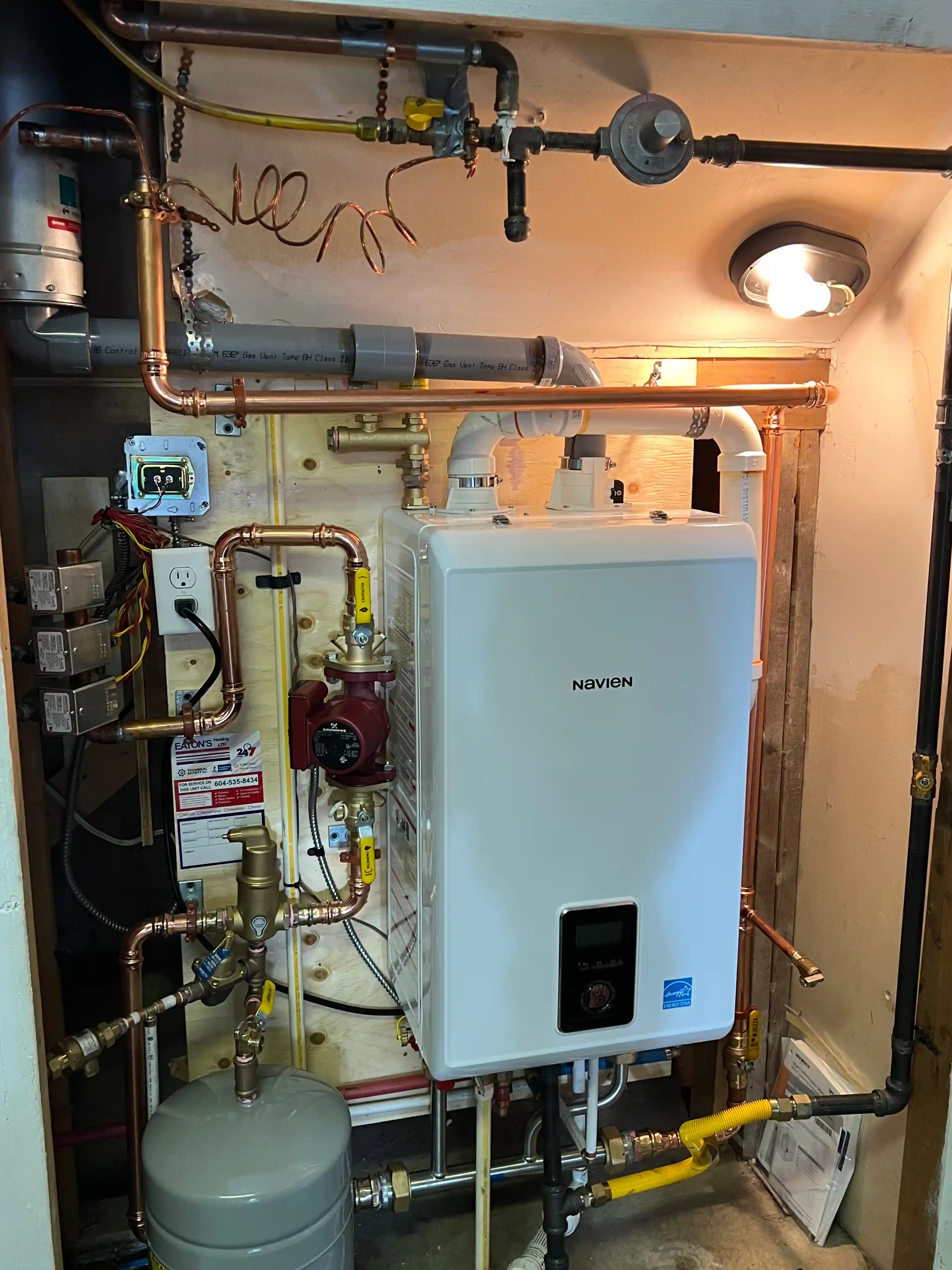
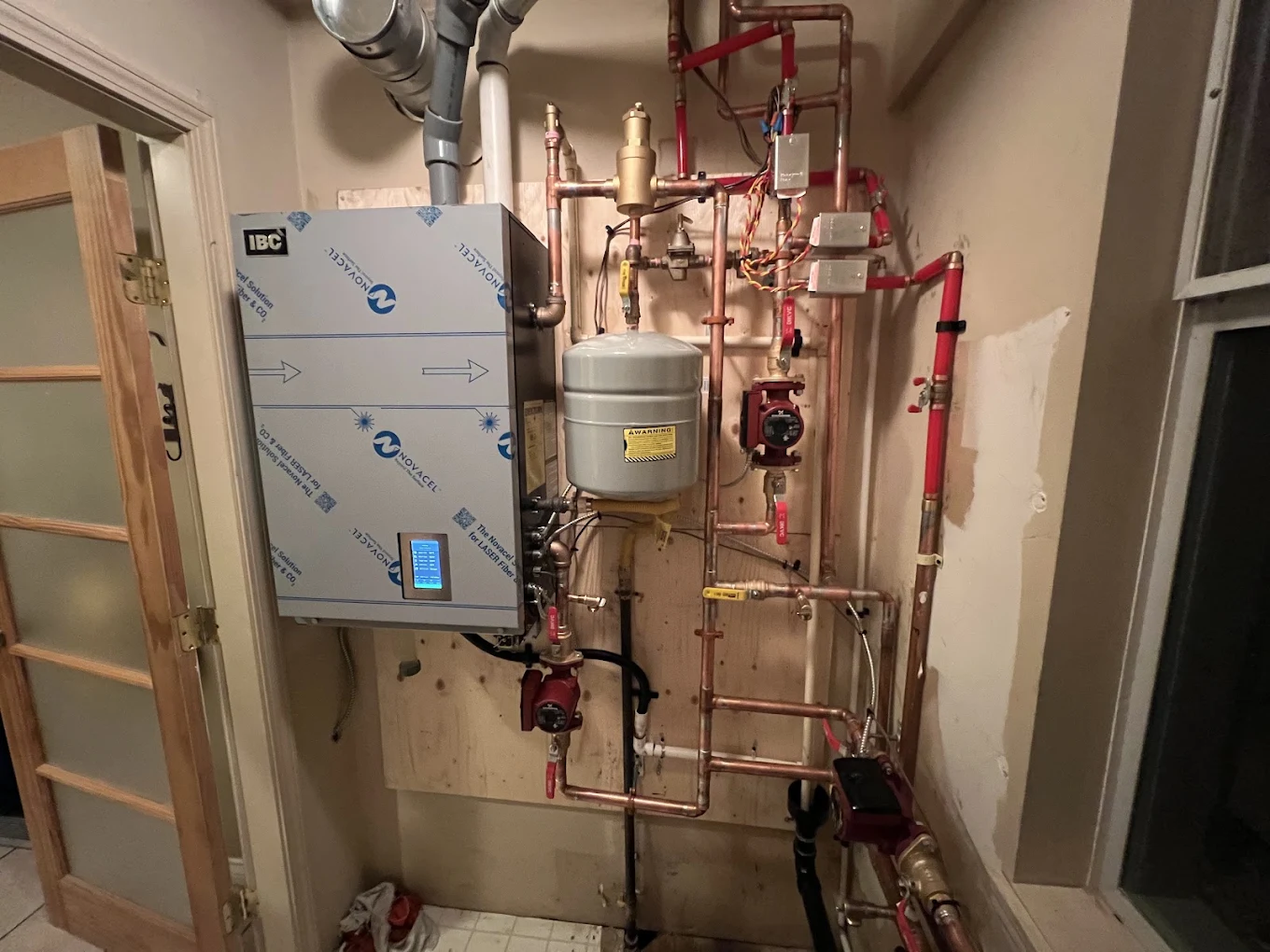
Two decades of hydronic repair across the full range of Metro Vancouver housing is what we bring to every Coquitlam boiler call. Eaton's Heating holds Technical Safety BC licence LGA0200006, FortisBC Trade Ally status, BBB A+ accreditation, and HPCN registration, with full WorkSafeBC coverage. Our technicians work on Navien, Viessmann, and Bosch condensing platforms as fluently as on legacy cast-iron systems from Weil-McLain, IBC, and NTI, and the difference between electronic fault code diagnostics on a modern wall-hung unit and hands-on pressure testing on a 40-year-old system is routine, not a stretch. Parts are OEM and CSA certified, with six months of coverage on parts and labour. Our 500-plus Google reviews at 4.9 reflect work that holds, diagnosed right the first time.
When the repair cost starts approaching what a modern condensing boiler would cost to install, we lay both numbers out clearly. The distribution, the radiators, the piping, the in-floor loops, is the expensive half of a hydronic home, and it is already in the walls and floors. A failed boiler almost never means abandoning that distribution; a new unit connects to the existing loop, and the home keeps heating the way the homeowner chose. Our boiler installation page for Coquitlam covers what a replacement includes and what drives the price. For homeowners considering a switch to forced air, we also install furnaces and heat pumps, though in most cases the existing hydronic distribution is an asset worth keeping.

A furnace that shuts down leaves the house cold. A boiler that starts leaking leaves the house cold and wet. A sealed hydronic system holds water under pressure, and when a fitting corrodes, a relief valve gives out, or a heat exchanger cracks, that water keeps flowing whether the boiler is running or not. In a finished basement, which is where most Coquitlam boilers sit, the damage to flooring and drywall compounds by the hour. That is why we treat any call involving visible water near the boiler or unexplained pressure loss as same-day priority, and being based in Coquitlam means the response time on those calls is the shortest in our service area.
If the repair estimate makes replacement the smarter spend, qualifying high-efficiency boiler systems can be eligible for FortisBC and CleanBC rebate programs. We confirm what currently applies to the specific unit being quoted and file the Trade Ally application after installation. Financeit at zero percent over 12 months is available.
Licensed Gas Contractor (LGA0200006)
Authorized Dealer and Installer
Certified Fireplace Dealer
Have a question about your HVAC system? Book an appointment using the form below, or call (604) 535-8434 for immediate help.
Faster than anywhere else we serve. Our office is in the city, and boiler calls involving leaks or pressure loss go to the front of the line because the damage does not pause when the boiler shuts off. For no-heat calls on radiant-only homes, where there is no furnace to fall back on, the same priority applies. Routine problems like a zone that will not warm or an occasional lockout book into regular slots, usually within a day or two. Call (604) 535-8434.
The range is wider than furnace repair because hydronic systems have more components outside the boiler itself. The diagnostic is $189 and covers tracing the fault through the full system: the boiler, the circulator, the zone valves, the expansion vessel, and the piping. From there, common repairs like expansion tanks, circulator pumps, zone valve actuators, ignition parts, and flame sensing components usually fall between $200 and $800 in parts and labour. Heat exchanger problems cost more and often shift the conversation toward replacement. Every number is quoted exactly, parts are OEM and CSA certified, and the warranty covers six months on parts and labour.
Almost always. A combi handles space heating and domestic hot water through a single burner and control board, so one fault typically takes down both. Which side failed first is a useful detail: hot water gone while the heating still works often points to the diverter valve or plate heat exchanger, while a full lockout usually traces to ignition, pressure, or flow. Combi failures get priority because the household loses two essentials at once. And if your hot water comes from a separate tank or tankless unit rather than the boiler, that falls under our tankless water heater or hot water tank service instead.
You need someone who works on hydronic systems regularly. A furnace technician knows combustion, gas, and airflow. A boiler technician needs all of that plus the ability to read a piped water system: measuring flow and pressure at multiple points, diagnosing zone valve and circulator problems, understanding expansion vessel behaviour, and knowing how to trace a leak through a closed loop. The difference shows up in accuracy. A furnace-focused company looking at a boiler that locks out may replace the ignition part and call it done. If the lockout was actually caused by low flow from a failing circulator, the new igniter solves nothing and the bill doubles. Our technicians handle hydronic systems every week, not once a season.
Pressure that drops and needs frequent topping up almost always means the sealed system is losing water somewhere. The leak could be at a radiator valve, a pipe joint behind a wall, a corroded fitting near the boiler, or less commonly the heat exchanger itself. A failed expansion vessel can look the same way: as the vessel loses its air charge, it stops absorbing the normal pressure swings that happen as water heats and cools, and the relief valve quietly releases small amounts of water each cycle. In older Coquitlam homes where the original piping and fittings are 40 or 50 years old, slow leaks at corroded joints are the most common source. The $189 diagnostic includes pressure testing the system to isolate the exact location.
Because February and March are month five and six of continuous operation, and that is when accumulated wear finally shows up. A circulator bearing that was fading since November gives out after months of daily use. A zone valve actuator that was sticking intermittently in December fails outright by March. Ignition components that fire hundreds of times a day wear down on a timeline measured in cycles, not calendar dates. In Coquitlam, where boilers run from October into April, late-season failures are the most common pattern we see. Scheduling a service visit in September or early October, before the heating season starts, catches these wear items before they become emergency calls.
Simply complete our form to make an appointment. A member of our team will be in touch to confirm your appointment.