
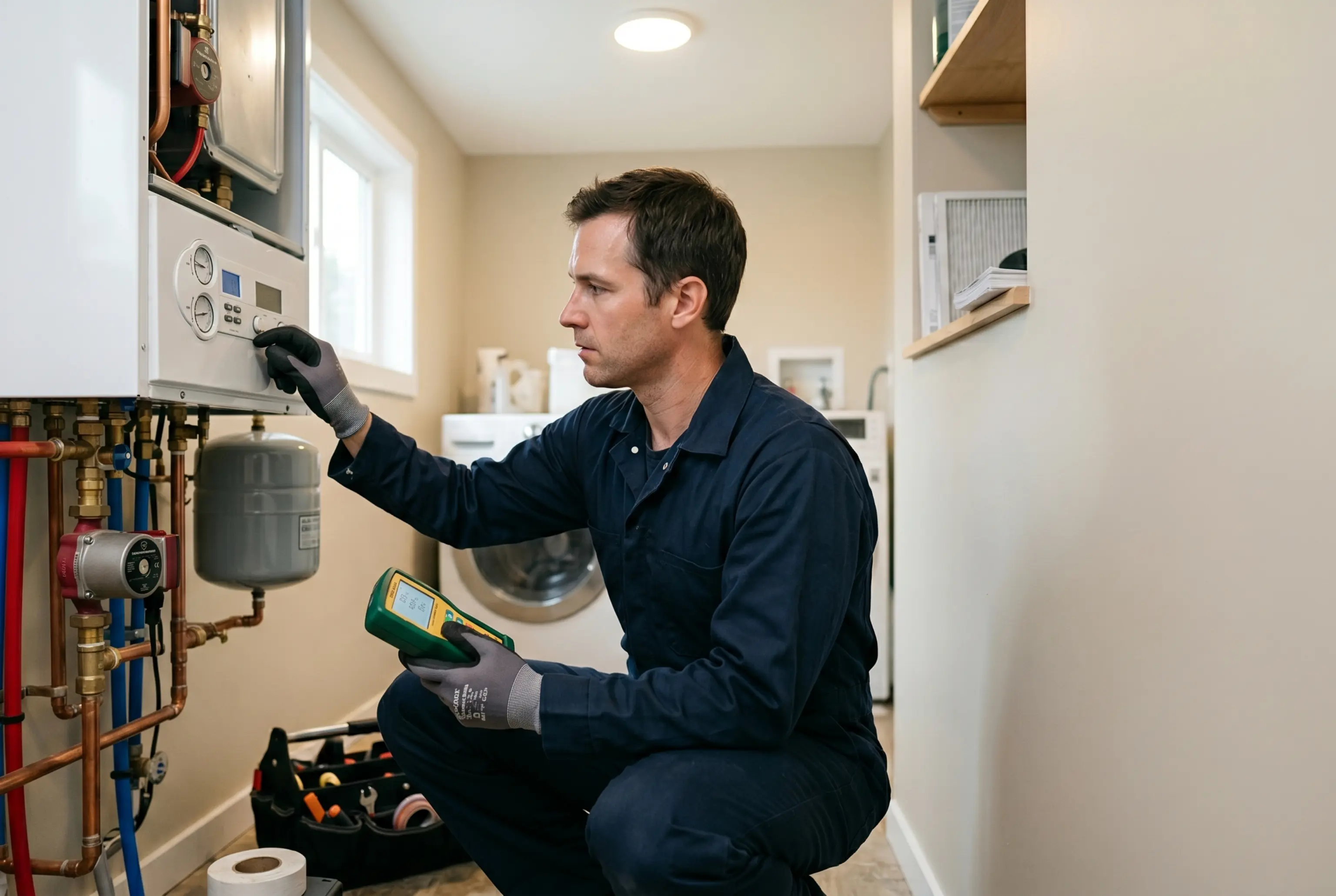
A lot of homes across Vancouver, the North Shore, New Westminster, and the older parts of Burnaby and the East Side run on hot water boiler heat: radiators, baseboard convectors, or in-floor radiant. When that system is working, it is the most comfortable heat there is, quiet, even, and easy to live with. When it stops working, it tends to do it in the middle of a cold snap, because that is when the boiler is working hardest.
Whether your boiler is making a noise it never used to make, leaving some rooms cold, losing pressure, or just overdue for a checkup, here is what is most likely going on, what a real boiler service includes, and how to tell the difference between a quick fix and a system that has reached the end of the line.
Boilers rarely fail without warning. Most give you signals for weeks or months first. The ones worth paying attention to:
Low pressure. The most common call we get. If the gauge sits below the normal range, the boiler may not fire at all. Sometimes it is as simple as bleeding the radiators and topping the system back up. Sometimes it is a leak or a failing pressure relief valve that needs to be tracked down.
Sludge buildup. This is the big one in older hydronic systems here. Over years, internal corrosion produces a black iron oxide sludge that settles in radiators and the heat exchanger, blocking flow and forcing the boiler to work harder. One advantage in Metro Vancouver: our water is very soft, so the hard limescale that plagues boilers in harder-water regions is much less of an issue here. The problem in our older homes is almost always sludge from internal corrosion rather than scale. Badly sludged systems sometimes need a power flush to clear them out.
Circulator pump failure. The pump moves hot water through the system. When it fails or seizes, the boiler may run but the heat never reaches your rooms. Pumps are a common wear item and a fairly straightforward replacement.
Ignition and pilot faults. Whether your boiler uses a standing pilot or electronic ignition, failure to light is a frequent fault. Causes range from a dirty flame sensor to a gas valve issue to a failed igniter.
Frozen condensate pipe. High-efficiency condensing boilers drain condensate through a small pipe, and if part of that run is exposed to the outdoors it can freeze during an Arctic outflow cold snap, which locks the boiler out right when you need it most. It is a common winter call and usually a quick thaw and re-route, but worth preventing.
Leaking seals, valves, or the expansion tank. Seals wear, valves fail, and waterlogged expansion tanks cause pressure problems. These are bread-and-butter repairs when caught early.
Thermostat and controls. Sometimes the boiler is fine and the problem is the thermostat or the controls telling it the wrong thing. Worth ruling out before assuming the worst.
A real boiler service is more than a glance and a wipe-down. When we service a boiler, the technician works through the whole system:
At the end, you get a clear picture of the boiler's condition and a heads-up on anything that is wearing out before it fails. The point of a service is to catch the small stuff in the fall, when a part can be ordered on a normal timeline, rather than in January when the system quits and the whole region's heating contractors are slammed.
Safety. A gas boiler with a combustion or venting problem can produce carbon monoxide. A service includes checking that the boiler is burning cleanly and venting properly, which is not something you can eyeball yourself.
Efficiency. A boiler that has drifted out of tune burns more gas for the same heat. Our heating season runs seven months, so an inefficient boiler quietly costs you money from October through April.
Fewer winter breakdowns. Boilers fail when they are working hardest, which is the worst possible time. A fall service is the cheapest insurance against a no-heat call during a cold week.
Warranty. Many manufacturers require documented annual servicing to keep the warranty valid. Skipping it can cost you coverage on an expensive component down the road.
Lifespan. A well-maintained boiler can run reliably for 15 to 20 years or more. A neglected one wears out faster and fails sooner.
Most boiler problems are worth repairing. A pump, a valve, an ignition component, or a pressure issue are all routine fixes that buy you years of reliable heat. Here is the rough framework:
Lean toward repair if:
Lean toward replacement if:
The honest version: if a repair costs a large fraction of what a new boiler would, and the unit is already near the end of its life, you are usually better off putting that money toward a replacement instead of a system that will need the next repair soon. We do both repairs and replacements, so when we tell you a repair is the smart move, it is because it actually is. If a replacement is the better call, we will explain why and quote it with no pressure. For homeowners weighing a switch away from hydronic heat entirely, our heat pump vs furnace and AC comparison walks through what that involves.
Boiler work is gas work, and in British Columbia gas work has to be performed by a Technical Safety BC licensed gas fitter. For a repair or service call, that means the person touching your boiler needs to be properly licensed, full stop. For a boiler replacement, a gas permit through Technical Safety BC is required, and a licensed gas contractor pulls it.
For homes with a secondary suite, a rental, or a strata designation, homeowner gas permits are not allowed under Technical Safety BC rules, so a licensed gas contractor has to handle it. Our boiler work is done by licensed gas fitters with over 20 years of experience across the Lower Mainland, the same standard we hold on every furnace and water heater job.
1. Are you a Technical Safety BC licensed gas fitter? Boiler repair and service is gas work. The person doing it needs to be licensed. If you want to verify, ask for the licence number.
2. Do you actually service my type of boiler? Hydronic systems vary, combi boilers, conventional boilers with a separate tank, condensing and non-condensing units, and different brands. You want someone who has worked on your kind of system. We service all major brands.
3. Will you give me an honest repair-or-replace read? A good contractor tells you when a repair makes sense and when it does not, instead of defaulting to whichever one pays them more. Because we do both, we have no reason to push you one way.
Once a year, ideally in late summer or early fall before the heating season starts. Annual servicing keeps the boiler running efficiently and safely, catches small problems before they become breakdowns, and is often required to keep the manufacturer warranty valid.
A boiler that needs topping up repeatedly usually has a leak somewhere in the system, a failing pressure relief valve, or a waterlogged expansion tank. Topping it up over and over treats the symptom, not the cause. It should be diagnosed so the actual source gets fixed.
Cold at the top of a radiator usually means trapped air that needs bleeding. Cold at the bottom usually means sludge has built up inside and is blocking water flow. Widespread cold radiators can also point to a circulator pump that is not moving water through the system.
A water leak should always be looked at, because small leaks grow and corrosion damages components over time. More importantly, any sign of a combustion or venting problem on a gas boiler is a safety issue because of the carbon monoxide risk. If you smell gas, leave and call the FortisBC emergency line. For a water leak or a boiler acting up, book a service call.
A well-maintained boiler typically lasts 15 to 20 years, and some good units run longer. Regular servicing is the single biggest factor in reaching the upper end of that range. Past 20 years, efficiency drops and the risk of a major component failure climbs.
A boiler service is a cleaning, a tune-up, and a safety inspection where needed. The technician cleans the components that need it, checks and adjusts the boiler so it's running efficiently, and inspects the combustion, venting, and safety controls to confirm it's operating safely. If a repair turns out to be needed, we explain it before doing any work, and if a replacement is the smarter move, we provide a free estimate with no obligation.
Yes. We service all major boiler brands and both combi and conventional systems across the Lower Mainland.
We repair, service, and replace boilers across the Lower Mainland and have been doing it for over 20 years. Our work is done by Technical Safety BC licensed gas fitters, and we will give you a straight answer on whether your boiler needs a repair, a service, or a replacement. You can see more about our boiler services here.
We serve homeowners across Vancouver, Burnaby, North Vancouver, New Westminster, Surrey, Coquitlam, Richmond, Port Coquitlam, Maple Ridge, and across Metro Vancouver.
Book a boiler service call or call us at (604) 535-8434.
See what our customers have to say
Simply complete our form to make an appointment. A member of our team will be in touch to confirm your appointment.