Bradford White, John Wood, and Rheem, Hot Water Tank Replacement, New Westminster
Eaton's Heating replaces and repairs gas hot water tanks across New Westminster. A replacement starts with a free estimate. From there you get a Bradford White, John Wood, or Rheem tank sized for your household and vented the way your house needs, installed and running the same day it arrives, with the old tank taken away. A tank that has stopped heating but is not leaking is often a repair rather than a replacement, and the technician tells you which on the visit. Same-day service available.


See what our customers have to say
Brands Serviced
Years of Experience
Homes Served and Counting
A hot water tank either leaks or stops heating, and the two are handled differently. A leak means the steel tank inside the jacket has rusted through, and the only fix is a new tank. A tank that stops making hot water while staying dry usually means the pilot has gone out, the thermocouple that holds the gas valve open has worn out, or the gas valve itself has failed, and those are repairs. Our technician tells you which on the visit. A hot water tank replacement is sized for the number of people and bathrooms in the house, so a couple in a Glenbrooke North bungalow and a family of five in a three-level West End house do not get the same tank, and the free estimate settles the size along with the price.
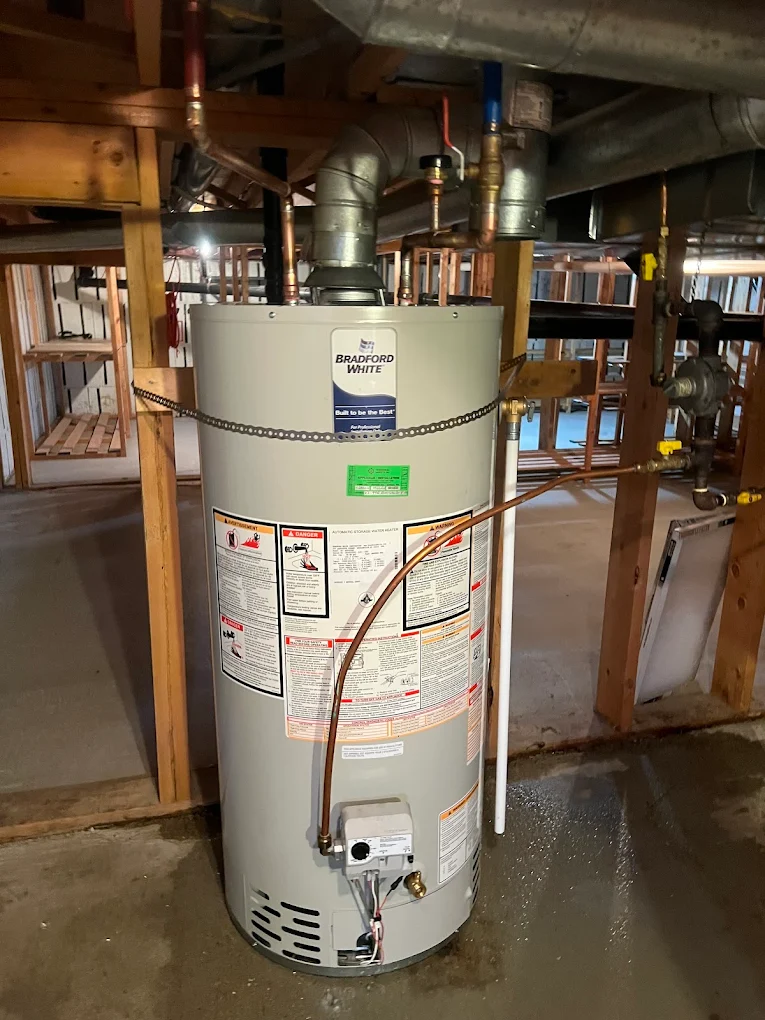
Where the new tank vents is decided by the house, not the homeowner. An atmospheric-vent tank is the simple one: its exhaust rises on its own through a metal pipe into a flue, with no fan and no power, and it is the right tank for a basement in Queen's Park, Sapperton, Glenbrooke North, or The Heights where a flue is already there. A power-vent tank has a small fan on top that pushes the exhaust out through plastic pipe to a sidewall, and it is the only option in a house with no flue, which includes the slab-built homes in Queensborough and the townhome closets in Queensborough and Victoria Hill. The estimate confirms which one your house takes, and where the vent already runs, the new tank connects to it.
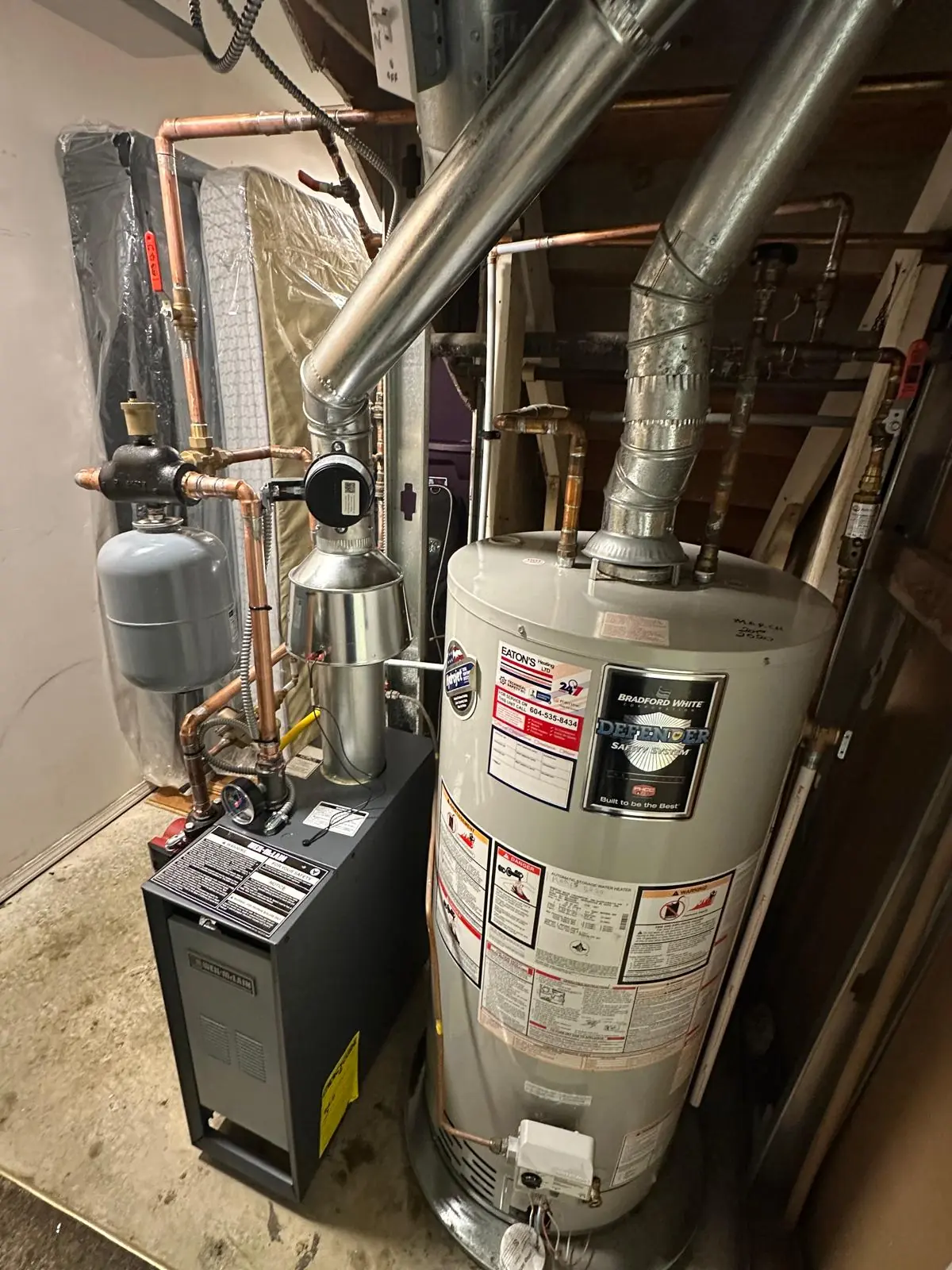
The tanks we replace here are either in a basement or in a closet. In the older houses, the tank is in the basement beside the furnace, sometimes in a corner under the stairs where the previous tank went in 15 years ago and nobody has looked since. In Queensborough and the townhomes, it is in a main-floor closet or beside the parking, where a leak has no floor drain to run to and gets noticed fast. Everything else we do in these neighbourhoods is on our New Westminster HVAC services page. Eaton's Heating is TSBC licensed (LGA0200006), a Home Performance Contractor Network member, and holds a 4.9 rating across 400-plus Google reviews.
On the installation visit the old tank is drained, disconnected from the water and gas, and carried out. The new tank is set in place, the water and gas are connected, the vent is connected or the power vent is run to the wall, and the tank is filled, fired, and checked for leaks at every joint. Where the house has a pressure reducing valve on the water line, the small valve that lowers street pressure for the house, an expansion tank is recommended and included in the estimate, because a closed system needs somewhere for heated water to expand. We take the old tank away. New hot water heaters are ordered after the estimate is approved and installed the day they arrive, so the house is without hot water for the hours of the swap, not for days.

When the hot water stops, the first question is whether the floor around the tank is wet. If it is dry, the tank itself is usually sound and the fault is in the gas side: the pilot has gone out, the thermocouple that holds the gas valve open has worn out, or the gas valve has failed. The thermocouple is the most common of the three on a tank past its first few years. It is a small part, it is on the truck, and replacing it is a short visit. A gas valve is a bigger part but still a repair on a tank that is not leaking. Either way the technician quotes it before touching the tank, and the hot water is back the same day when the part is on hand.
If the floor is wet and the water is coming from the tank itself, from the seam, the base, or the jacket, the tank has rusted through and no repair will hold. That is a replacement, and the sooner the better, because a slow leak becomes a fast one. Water from a fitting on top of the tank, or from the pressure relief valve on the side, is different: those are connections and valves, and they are repairs. When you call, tell us whether the floor is wet and where the water seems to be coming from, and the technician arrives ready for the right job.
Licensed Gas Contractor (LGA0200006)
Authorized Dealer and Installer
Certified Fireplace Dealer
Have a question about your HVAC system? Book an appointment using the form below, or call (604) 535-8434 for immediate help.
Most hot water tank replacements we do land between $2,200 and $2,600 installed, and the free estimate gives you the exact number for your house. That covers the tank, the connections, the venting, and removal of the old tank. Where an expansion tank is needed it is in the estimate too.
Turn the cold water valve on the pipe above the tank clockwise until it stops, which cuts the supply into the tank, and call us. A tank that is leaking from its body is a replacement, so the estimate is the next step. If the water is coming from a fitting on top or from the relief valve on the side rather than the tank itself, it is a repair, and the technician will tell you which when they see it.
Probably not. A dry tank that has stopped heating almost always has a gas-side fault: a pilot that has gone out, a worn thermocouple, or a failed gas valve. All three are repairs, quoted before the work starts. If the pilot relights and goes out again within a day or two, that is the thermocouple, and it is a same-visit repair.
Look at the top of the tank. A metal pipe rising into a larger metal or brick flue means atmospheric vent. A plastic pipe running sideways to an outside wall, with a small fan housing on top of the tank, means power vent. It matters because the replacement has to be the same type unless the vent route changes, and power-vent tanks cost more. In New Westminster, basements with a flue take atmospheric and Queensborough slab homes and townhome closets take power vent.
The tank is ordered after you approve the estimate, and it is installed the day it arrives, which is usually within a day or two. The swap itself takes a few hours, and the hot water is back before we leave. If the tank has failed and you are without hot water, tell us when you call.
Sometimes. A tank is the lower-cost replacement and the right answer for most New Westminster homes, and it can be done quickly. A tankless water heater costs more, needs a larger gas line in many older houses, and is worth it where the household runs out of hot water regularly or wants the floor space back. The free estimate can price both so you decide with real numbers.
Simply complete our form to make an appointment. A member of our team will be in touch to confirm your appointment.