
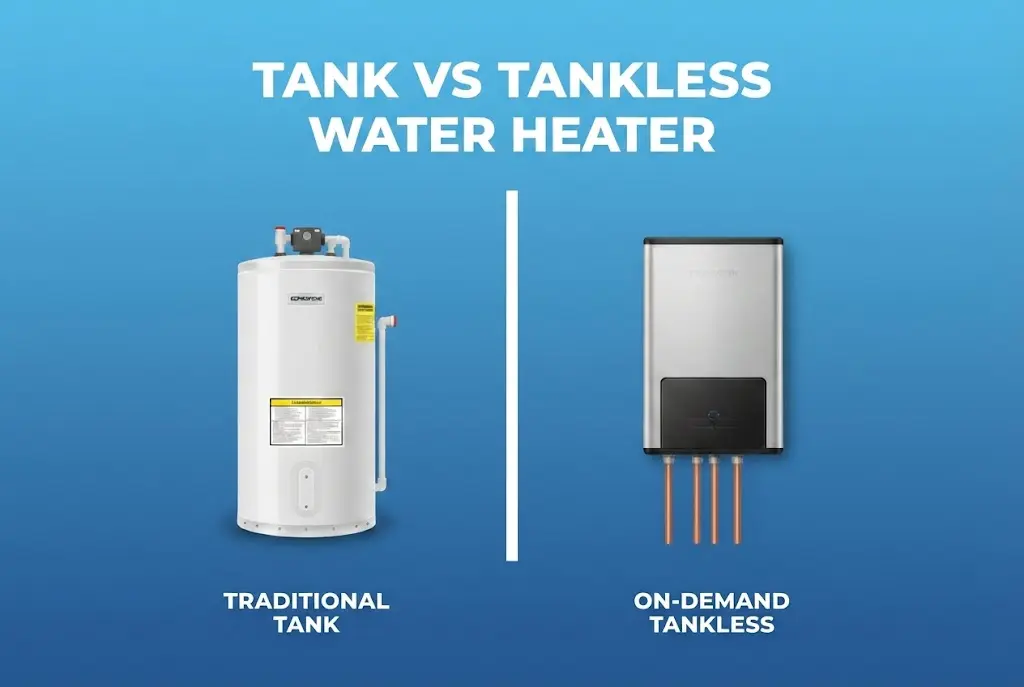
Metro Vancouver sits in a unique position when it comes to water heaters. The region's drinking water comes from rainfall and snowmelt captured in the Capilano, Seymour, and Coquitlam watersheds, which makes it some of the softest municipal water in Canada at roughly 0.3 grains per gallon. That soft water has a direct impact on how long your water heater lasts and how much maintenance it needs, whether you go with a tank or tankless system.
At the same time, the Lower Mainland deals with seasonal challenges that affect water heater performance and failure rates. Atmospheric river events like the one that hit the region in October 2024, driving Capilano source water turbidity to 20 NTU, put extra stress on plumbing systems. And every November through February, our service calls spike as aging tanks give out during the weeks when hot water demand is highest.
If you are comparing a tank vs. tankless water heater for your home in Vancouver, Burnaby, Surrey, Coquitlam, or anywhere else in the Lower Mainland, here is what the decision actually looks like with local pricing, local water conditions, and local permit requirements factored in.
A standard tank water heater installation in the Lower Mainland runs between $2,300 and $2,800 for a 40 to 50 gallon natural gas unit. That price includes the tank itself, basic atmospheric venting, removal and disposal of the old unit, and labour. Brands commonly installed in this region include Rheem, Bradford White, and John Wood.
If your home requires a power vent water heater because the installation location does not support conventional atmospheric venting, expect to pay $3,500 and up. Power vent models are common in newer Lower Mainland homes where the mechanical room sits in an interior space without direct access to a vertical chimney. They are also required in many basement suite configurations where the water heater shares space with living areas and needs sealed combustion venting for safety.
One thing to know about tank water heaters and our local water: because Metro Vancouver's supply is so soft, you get less mineral buildup inside the tank compared to homeowners in the Fraser Valley or Okanagan who are on harder well water. That means tanks in Vancouver, Burnaby, and the Tri-Cities tend to last closer to the upper end of their 10 to 12 year lifespan, assuming the anode rod gets checked every few years.
A properly installed tankless water heater in Vancouver costs between $5,500 and $7,500 for a whole-home natural gas unit. That range covers the unit itself (typically Navien, Rinnai, or Noritz), stainless steel venting, condensate drain line, gas line upgrades where needed, and labour.
The wide range exists because of what your home needs before the tankless unit can go in. Many homes in East Vancouver, Burnaby, and New Westminster built before 2000 have half-inch gas lines that cannot deliver enough volume to power a tankless unit. Upgrading to three-quarter-inch gas line adds $300 to $800 depending on how far the run is from the meter. If you already have adequate gas supply and venting from a previous tankless installation, a straight swap may come in closer to the lower end of that range.
The space savings matter in the Lower Mainland more than in most markets. A tankless unit mounts on a wall and frees up several square feet of floor space. In neighbourhoods like East Van, Marpole, and parts of Burnaby where basement suites are common, that freed-up space in a tight mechanical room can make the difference between passing a secondary suite inspection and needing to reconfigure the layout.
In British Columbia, every gas water heater installation or replacement requires a gas permit through Technical Safety BC (TSBC). This applies to both tank and tankless systems. Your licensed contractor should be pulling this permit on your behalf before any work begins.
Here is where it gets relevant to homeowners with rental suites or duplexes: if your property has a secondary suite, you are not eligible for a homeowner gas permit under TSBC rules. You must hire a licensed gas contractor. The same applies to strata properties, co-op ownership, and any multi-family configuration. A licensed contractor will pull the commercial installation permit, complete the work, and submit the notification of completion to TSBC.
If someone offers to install your water heater without mentioning the permit, that is a red flag. Unpermitted gas work can void your home insurance, and TSBC has enforcement authority under the BC Safety Standards Act. We pull permits on every installation and include the cost in our quotes so there are no surprises.
Water hardness is one of the biggest factors in tankless water heater maintenance, and it works heavily in favour of Lower Mainland homeowners.
Metro Vancouver's water measures around 0.3 grains per gallon, which is classified as very soft. For comparison, water in Kelowna ranges from 7 to 11 grains per gallon, and parts of the Fraser Valley with well water can exceed 15 grains. Hard water causes calcium and lime scale to build up inside a tankless heat exchanger, which reduces efficiency and can cause the unit to shut down with an error code if left unchecked.
With Vancouver's soft water, you still need to flush your tankless unit, but the interval is more forgiving. We recommend a vinegar descale once every 12 to 18 months for homes on the Metro Vancouver municipal supply. Homeowners in areas with harder water often need to flush every 6 months. A professional tankless flush runs $150 to $200, or you can do it yourself with a pump kit and white vinegar for about $30 in materials.
FortisBC currently offers a $50 rebate on tankless water heater maintenance when the service is performed by a licensed gas contractor. It covers roughly a third of the annual service cost.
Water heater failures in this region follow a predictable seasonal pattern. The highest volume of emergency calls we handle comes between November and February, when incoming water temperatures drop and tanks have to work harder to reach the set temperature. A tank that has been slowly corroding for years will often give out during a cold snap when demand spikes.
The atmospheric river season, which typically runs from October through January in the Lower Mainland, also plays a role. Heavy rainfall events can cause shifts in municipal water pressure and temperature. While Metro Vancouver's filtration infrastructure handles turbidity well, older tanks in homes across Surrey, Langley, and Maple Ridge that are nearing end of life are more vulnerable to failure during these high-demand periods.
If your tank is over 8 years old, the best time to replace it is in the spring or summer when scheduling is easier and you are not dealing with an emergency. Same-day or next-day installation is common for tank replacements during slower months. Tankless installations typically take a full day and benefit from the same off-season scheduling advantage.
A tank water heater is the better fit if you have a smaller household of one to three people with steady hot water usage, your existing gas line and venting are in good condition, you want the lowest upfront cost for a reliable system, or you are planning to sell the home within the next five years and want to keep your investment modest. Tanks are also the faster solution if your current unit has already failed, since they are almost always available for same-day or next-day installation.
A tankless water heater makes more sense if you have four or more people in the household and regularly run out of hot water, you plan to stay in the home long enough to recover the higher upfront cost over 10 or more years, you need the wall-mounted space savings for a basement suite mechanical room, you are already doing a renovation that includes gas line and venting work, or you want continuous hot water without worrying about a tank running empty during back-to-back showers.
1. Has your gas line been sized for the new unit? Many older Lower Mainland homes have half-inch gas lines that are fine for a 40-gallon tank but cannot supply enough gas for a tankless unit. A qualified installer will measure your gas line diameter, check the BTU load of your other gas appliances, and tell you upfront if an upgrade is needed. If someone quotes you a tankless installation without inspecting the gas supply, get a second opinion.
2. Do you lose power often in your area? A conventional gas tank water heater with atmospheric venting works during a power outage because it does not need electricity. Most gas tankless units require power for ignition and electronic controls. If you are in a part of North Vancouver, Coquitlam, or Maple Ridge where winter storms knock out power regularly, factor in the cost of a battery backup or small UPS at $100 to $200.
3. Will you actually do the maintenance? Tankless units need annual or biannual flushing to perform well over their 20-plus year lifespan. If you are the type of homeowner who will schedule that service, the long-term savings and longevity of tankless are real. If the unit is going to sit untouched for years, a quality tank from Bradford White or Rheem will serve you well with almost no maintenance required.
We install both tank and tankless water heaters across the Lower Mainland and have been doing so for over 20 years. If you are not sure which direction makes sense, we will inspect your gas line, check your venting situation, confirm whether your home needs a standard or power vent model, and give you a transparent quote for both systems so you can compare side by side.
Every installation includes the Technical Safety BC gas permit, removal and disposal of your old unit, and a written warranty.
Book a free water heater estimate or call us at (604) 535-8434.
See what our customers have to say
Simply complete our form to make an appointment. A member of our team will be in touch to confirm your appointment.